
The topic of female rage has been increasing in popularity in the past few years, thanks in no small part to features like Raw, Anatomy of a Fall, The Substance, Promising Young Woman and others; which apart from standing out as features portraying raw and, mostly, uncensored anger towards the societal burdens of femininity, also have in common a very specific factor: they were all directed by women.
Of course, the discussion surrounding these features almost always brings us back to the age old question of whether men are talented or indeed empathetic enough to write and direct stories centred around womanhood with the same passion, realism and raw emotion as we are able to write about ourselves; and although features like Midsommar might indicate that the type of suffering which unites the genders, the anguish of human life that many mistake for female rage, can certainly be brought to life through a man’s voice on a woman’s body, it is features like the one we will be discussing today which remind us that there are certain things, certain depths, that only a woman can reach.
Your Monster is a 2024 romantic comedy-horror feature written and directed by Caroline Lindy and based on her short-film of the same name. It stars Melissa Barrera in the main role of Laura Franco and Tommy Dewey as the titular Monster, with side characters played by Meghann Fahy and Edmund Donovan.
Being the debut feature of Lindy, the film was made on a $300,000 budget, grossing a little over twice that amount, an impressive run for an indie debut and an even more impressive use of budget for such a well-made and well-crafted film.

Your Monster follows Laura, a young actress who is dumped by her playwright boyfriend after being diagnosed with cancer and is forced to move out of their apartment and back into her childhood home, only to find out that the monster she believed lived in her closet as a child is indeed real and wants her out of the house.
It is a fantastic genre-mashup made even more unique by its clever script, beautiful costuming and the incredible performance of Barrera as a woman who increasingly loses bits and pieces of her sanity until she passes the point of no return. One might say that point leads to freedom, others may disagree.
The overall themes of the film are pretty clear: Monster, who never truly gets a name and is therefore only known by what he is, is a manifestation of Laura’s inner fear and desire, her need for love and her want for freedom, which she’s been denied by the men in her life ever since childhood. Her wants have been ignored for so long that all the furious rage, fear, disgust and lust which inhabit her take the shape of a short-tempered and sharp-toothed werewolf-ish beast who pushes her to liberate herself from the societal handcuffs containing her; perhaps a bit too much, in the end, depending on your interpretation.
Monster is a very clever plot-device, and although werewolves and adjacent have often been used in cinema to represent repressed desire and hidden anger, it is not often we see a woman fall in love with the madness living within herself, and finding freedom by not only accepting her anger but embracing it to the fullest.
Your Monster has all the marks of a future indie classic, a feature which didn’t make that big of a splash upon release, but is one we will be talking about for generations, both in terms of creative film making (costume design, set design, makeup) and interpretation of such a unique text.
The thing that perhaps makes the movie so fascinating to me, is the position of Laura as a “standby-protagonist”; in the sense that, although she is established as the type of person who just allows things to happen to her without protest in fear of overstepping or hurting people, her inner voice, the Monster, really takes centre stage in the text, liberating her from her people-pleasing self and showing her she can be so much more than just a doormat.
The monster, whose name is literally the title of the movie, stands out in every scene he’s in. And although he is Laura (hence why “Your Monster”, which implies not only that he literally inhabits Laura, but as he states in the end, he is hers, which to this writer could signify not only the belonging, but belonging to her specifically, implying that we all have a monster inside) she doesn’t seem to accept that until the end, so her other-half, the part of herself she refuses to acknowledge, ends up serving as the real protagonist.
Let’s Talk Costuming
Your Monster was costumed by Matthew Simonelli, who seems like a new name in the costume design world, having acted as an assistant costume designer in Orange is the New Black and costume fitter in The Hunger Games: Mockingjay – Part 2.
Simonelli did something quite difficult to do in a proper way: he managed to capture the heart and soul of all of us theatre freaks who have been called “eccentric”, or, plainly really fucking weird.
There’s a smooth extravagance in Laura’s manner of dressing. She’s so unapologetically herself in her way of expressing through clothing, seemingly going for nearly always extremely comfortable clothes, but in interesting colours and creative shapes, making her wardrobe an extension of her work, and perhaps a way to always feel the euphoria of being on stage.
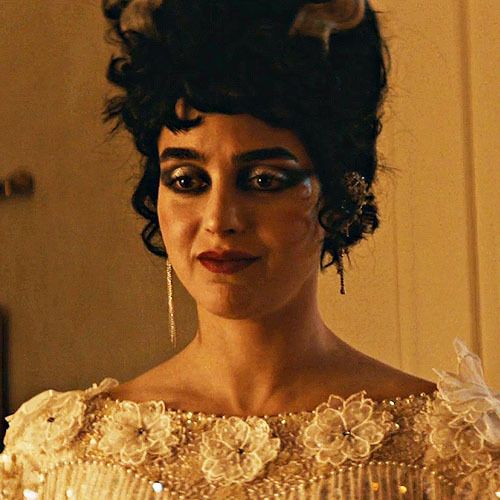
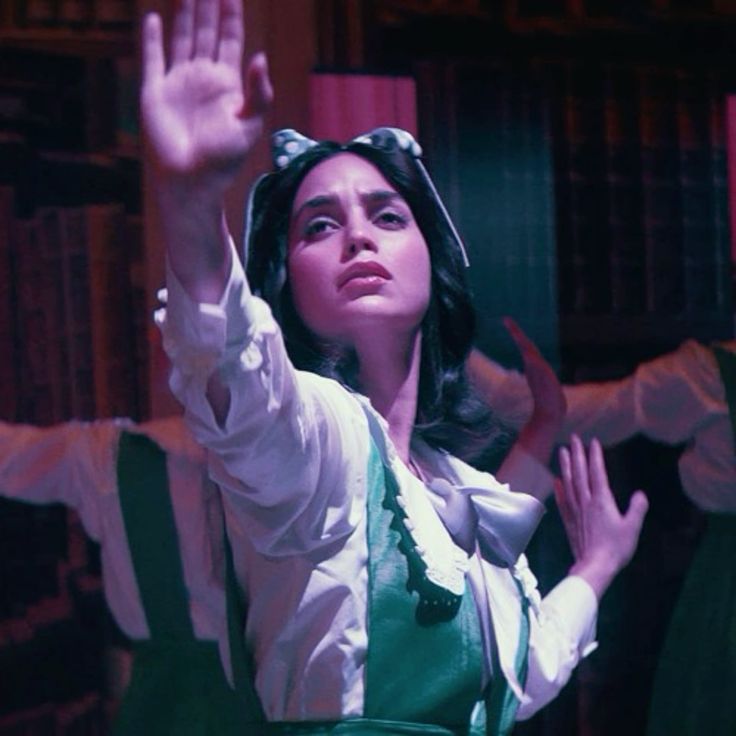
As the movie progresses, she gets bolder and bolder with her choice of clothing; with more experimental colours and hairstyles, culminating in her fantastic homage to the Bride of Frankenstein during the theatre’s halloween party.
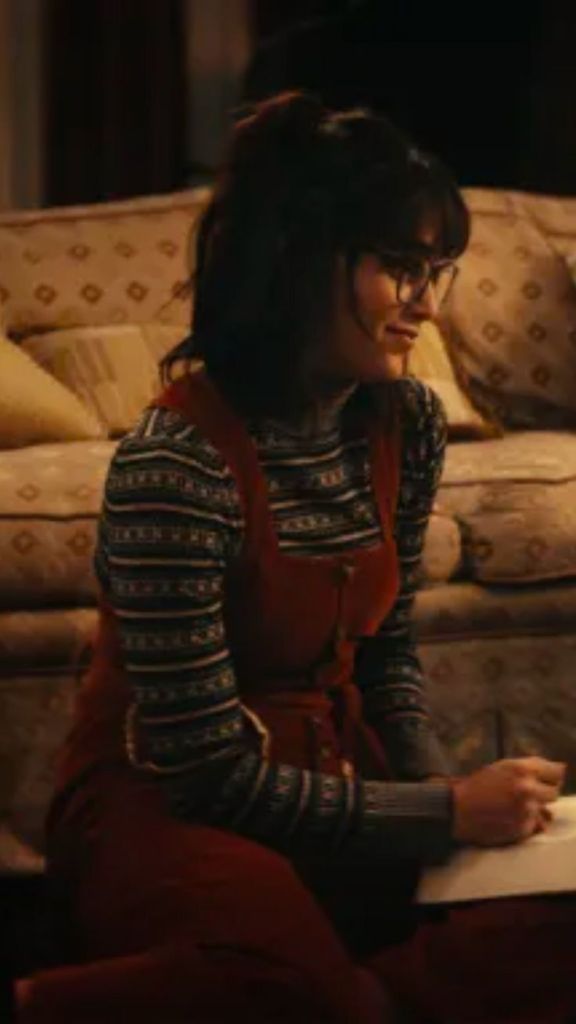
My favourite pieces, though, are the red overalls she wears when reading with Monster, in a scene where he revels his love for theatre and poetry. She pairs them with a long sleeve striped sweater and thick black glasses, which in any other context would scream manic pixie dream girl but feel so incredibly natural and fitting for the playful and theatrical atmosphere of the movie. That scene is absolutely adorable, one of the standout scenes of the movie for me, and it shows how Laura is so comfortable and in her element around Monster that there are no longer any barriers up.
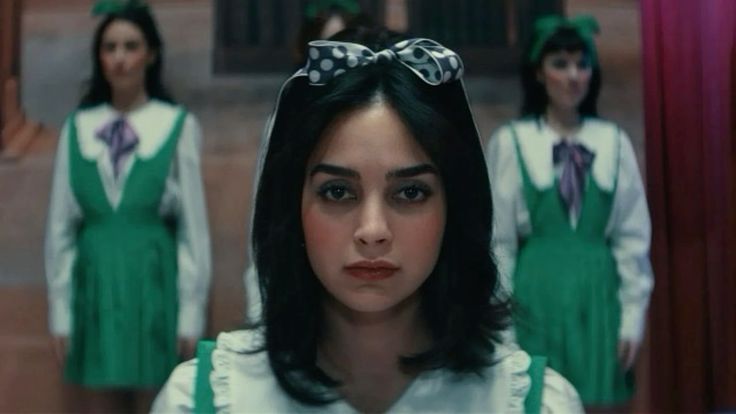
The second greatest piece of costuming is the uniform she wears on stage, during the climax of the movie. It is everything Laura herself has become: brightly coloured, sharp edges, in your face. There’s the polish of theatre there, with the heavy makeup and overdone hair with the big exaggerated bow, but it’s still her; it is her role, after all.
Costuming and visuals aside, however, Your Monster finds its footing in the depiction of something we seldom see onscreen as well developed as we see here: the nuances of female friendship and how the patriarchy affects every single aspect of womanhood, including and most importantly the way we interact with each other.
The movie features two examples of female friendship, one occurring more often than the other, through the main character’s relationship with two women: Mazie and Jackie.
Mazie is initially introduced as Laura’s only friend. Albeit late, she’s the one who comes to pick Laura up from the hospital after her surgery. She drives the main character home, but leaves promptly as she’s got other plans, leaving Laura alone in her childhood home to fend for herself so soon after such life altering events.
Midway through the movie Laura experiences her first moment of outward anger, blowing up at her ex-boyfriend for the way he’s treating the lead actress, Jackie. To this Mazie responds by acting cold and annoyed at Laura, telling her it is not her place as an actress to critique the director or the way he speaks to his actors, and it would do her some good to simply stay silent. Furthermore, Mazie agrees with his treatment of Jackie, stating she’s not talented enough for the role, and stressing Laura should hate the girl for taking away her role. When Laura then critiques Mazie’s behaviour towards her, stating she’s not a very good friend, Mazie gets defensive and states Laura will end up alone if she continues down this path, adding she should go back to being herself, i.e the silent, agreeable, afraid person she’s always been.
Soon after, Laura begins to connect with Jackie, who is apologetic and embarrassed at the fact the entire cast seemed to assume she was in a relationship with their director and playwright, Jacob.
Jackie explains to Laura that her relationship with Jacob is, in her view, completely professional, and she’s uncomfortable with his advances, having expressed her discomfort to him but being completely ignored. Laura combats this information by stating she saw Jackie and Jacob being intimate during the company’s Halloween party, but is immediately told that is not true and they’ve never done anything close to that, which is when Laura and the audience discover the person Jacob had sex with at the party was, in fact, Mazie, which has apparently been going on for a while, sending Laura down a furious path of no return.
However, after finding out about Laura’s relationship with the director, as well as how he treated her during and after their relationship, Jackie becomes immediately compassionate and forms a bond with Laura, having seen her as a talented actress and an equal from the beginning. It surprises Laura to realise Jackie has never bore any ill will towards her, but was simply unaware of the full picture, as well as being yet another one of Jacob’s victims. It was Mazie who saw Laura as competition.
Mazie exemplifies a very common real occurrence in women’s lives. The friend who is, in fact, not your friend, because she is incapable of building such a connection, being stuck in the mindset that only herself and her own needs truly matter. Mazie is a species of bloodsucker, staying around Laura so she can leech off her and enjoy the benefits while doing – sometimes even less than – the bare minimum to keep the facade of friendship. This all culminates in Mazie using her body as a way to advance her career, choosing to target Jacob seemingly both because he once “belonged” to the object of her envy and in an attempt to help herself.
From childhood, women are taught to see each other as competition. We compete with each other in big and small ways throughout our lives, but the main objective is always the same: men.
Men, in women’s lives, represent safety and self-preservation. Their presence is supposed to allow us to exist without care, to be comfortable in that fact that, much like a dog, having an owner will protect us. That is also how I chose to interpret Sabrina Carpenter’s Man’s Best Friend album cover, even if the artist’s own views seem to differ.
Mazie sees Jacob as both a safe haven and a tool of success, the full-package, one might say. It is not rare for women to hear that our bodies hold power, but only as long as we are within the ages of 12 and 25, and these weapons God has given us can be used to obtain things we’re supposed to want, things we’re supposed to desire, things that will supposedly keep us safe.
For Mazie, that is her career, and the knowledge that she has succeeded in her womanly mission and has a man by her side, and one many women desire, regardless of whether he’s a good person, a good provider or indeed someone she enjoys being around. It is, of course, an incredibly shitty thing to do to a friend, but due to the competitive nature of female friendships and the she hates you because you’re pretty narrative we are fed from birth, Mazie has learned that burning some bridges is a small price to pay for the security of having what she wants. The security of achieving her only goal.
But Jacob, who represents the patriarchal force existing within the entertainment industry, is the one leading this sin. It is important that Jacob is the one who represents the misogyny and sexual abuse happening in the industry, as his nice guy facade, with the sweaters, literature and tea, is used specifically to deceive his victims as to what lies underneath.
His disregard for his ex is made clear by his involvement with her best friend, but also his lack of professionalism and predatory nature is shown when it is made clear Mazie and Jackie are both two sides of the same coin: women who have been approached by the man who holds their careers in his hands and are, therefore, forced to be subjected to whatever he wishes in fear of losing their jobs and livelihoods. It might be, in the end, that Mazie believes her willingness to sleep with Jacob to be a completely consensual transaction, but would she still be attracted to him if he wasn’t a director? Would she still want him if he didn’t hold power over her? Was her involvement with him real or was she telling herself it was consensual to protect herself from the truth, which is her fear of denying him access to her body given he could make sure she never worked again.
Jacob abuses his power as a figure of authority to sleep with his actresses, and although they react differently to his approach, they represent many women in the industry. Mazie gives her body to him thinking it will save her, when in reality she’s just giving him what he wants without the certainty that her side of the deal will be honoured and knowing, if this comes out, it will look so much worse for her than it ever will for him, both as an actress and the guilty party in the “stealing your friends’ boyfriend” narrative; Jackie, on the other hand, plays nice and kind, afraid of upsetting the man who could fire her for any reason he wishes and seems easily angered, representing women from many different sections of life who have had to deal with harassment with their head down for their own safety; and Laura is the failed muse, serving initially as inspiration for Jacob, but as soon as her life didn’t go according to his plan, and worse, she dared to show that she is out of his control, her career was over.
It is especially important to the narrative of this feminist feature that the person to die in the end isn’t Mazie, but that doesn’t mean she’s getting away scotch-free. She’s still, and will always be, the woman who fucked her friend’s ex-boyfriend, as well as the woman who slept with her director, and while both are morally wrong in different ways, one holds a lot more negative judgement in the court of public opinion than the other.
Importantly, through these women’s relationship with Jacob we are introduced to a new layer of the script: romantic trauma and it’s consequences on women’s lives.
Two of our female characters can help us analyse the way romantic trauma has an everlasting impact, Laura and Jackie.
Jackie’s trauma is a lot simpler to understand; she’s a stand-in for all women who have been sexually and morally harassed in their industry. In her case, she’s shown to have stayed silent towards Jacob’s advances, choosing to not say yes or no for fear of the affect that would have on her livelihood. Her lack of response towards Jacob’s feelings eventually results in his berating and humiliating her in public, with the excuse that he was “correcting” her performance, which has no doubt been affected by her anxiety in having to deal with his sexual harassment and the knowledge that turning down a man in power has a very high chance of backfiring on her. She is the character who shows us what happens, internally and externally, if we choose to stay silent about sexual harassment and assault, and how important it is to have a community which supports and believes victims, making survivors comfortable and fearless to speak out about this type of violence.
The character seems on edge for most of the movie, undoubtedly because she’s used to being sexually harassed. Of course, sexual harassment is unfortunately something every woman can understand and has experienced, however Jackie’s experience with it is very specific to her career. In the beginning, we see the way women around her snicker, as we have been taught to, and doubt her talent, attributing her success to her beauty, as she is the very picture of traditional western beauty ideals. This extends throughout the film, with people assuming her to be arrogant, talentless and stupid due to small mistakes she makes in social situations, refusing to give her the benefit of the doubt. Her anxiety and understanding on dealing with the toxicity of men in her business is what ultimately brings her close to our second, and most important, example of trauma: Laura.
Laura’s trauma comes from more than simply her relationship. On one hand, she’s an ethnically diverse woman whose identity is nearly never represented on her career of choice, with the exception of two or three musicals. It is clear that is a leading insecurity for her, the fear of not belonging, which is further reinforced by the presence of Jacob in her life.
Jacob is coded to be the type of man who appears cuddly and kind on the surface, but uses his intelligence to seek women who can serve as muses, without outshining him. He is, at his core, a small, fragile and insecure man, who feels big only when he can show the world what a wonderful little pet the woman he chose is, establishing his power and perceived superiority.
In the beginning of the movie, it is said Jacob and Laura have been together for years, and towards the middle, we find out the play he wrote is actually based on her life experience in a boarding school, and although we do not know what the experiences are, since we never see the full play, it is implied Laura was taken advantage of by an older man when she was in her teens, leaving her scarred by this experience which is then exploited by Jacob to create his masterpiece.
Through these bits, we can understand that Jacob’s relationship with Laura is purely with the purpose of using her. Her life, her story, her voice, her labour which she brings up during her meltdown moment, stating she did everything for him and he never needed to lift a finger, in a monologue that reminds me of A Part of That from the musical The Last Five Years.
This relationship can be described with only one word: draining. Jacob sucks up every single part of Laura, and disposes of her without a second thought as soon as she can no longer be used for his personal entertainment, leaving the already scarred woman lost and confused as to what her life will become now, both from a livelihood and romantic perspective.
As we can see in the beginning of the movie, Laura is so absolutely starved for human connection that she hugs her delivery man and cries when Monster tells her she must move out. And by the middle, it becomes clear that Laura craves relationships so much she created Monster to love her like nobody ever has, and how she’s always hoped to be loved. In the end, Laura learns that the greatest love of her life is in fact herself, and she mustn’t wait for someone else to tell her what to do or teach her how to reach her potential, and we can only hope that this realisation serves as an inspiration for Jackie to also become more outspoken and independent of the abuse she has suffered.
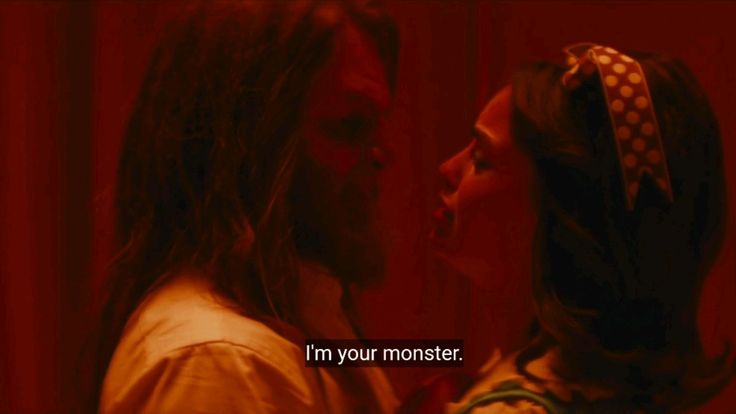
It would be impossible to speak of Your Monster without mentioning the main attraction which has led many a sad theatre freak to this movie: the enormous appeal of monster fucking as a genre.
Monster Fucking, also known formally under Monster Erotica, has been growing in popularity in the past decade, and much of it’s popularity and history has to do with something implicit in the script of Your Monster: female sexual liberation and the freedom from repression.
In literature, monster erotica can be identified in the west by the 1800s, in works such as Carmilla by Sheridan Le Fanu from 1872 and Bram Stocker’s Dracula, from 1897, although nowadays works of fiction featuring sexual relationships between vampires or zombies and humans aren’t always categorised under monster erotica, given these creatures were once human themselves.
In the east, however, monster erotica has been around more explicitly for a longer time, having been first introduced through paintings in the late 1700s. These works, like Tamatori Escaping from the Dragon King by Utagawa Kuniyosh from 1844, which, as the title implies, is a work which also features sexual violence being inflicted on the woman by the dragon king, a common plot point of monster erotica, and an extension of taboo fiction which has grown in popularity in the 2010s due to the resurgence of fanfiction and fantasy fiction sites like Wattpad, and the ease with which authors can self-publish, bringing a genre that was already wildly popular in the East to the West in a boom which seems to expand the market with every passing month.
Monster Erotica differentiates itself from bestiality by existing in the line between human and animal. The monsters in this genre are always portrayed as sharing key traits with humans, such as capacity for intelligent thought and logic, or the possession of human appendages like a penis. Monster, for example, is human in every way but for his incredibly hairy body and wolf-ish facial features, being more of a human-puppy.
It is fascinating to ponder as to the reasons why monster erotica went from being a genre entirely dominated by men, where they undoubtedly saw themselves as the angry monster coming to deflower and young unwilling maiden, to a genre now considered inherently feminine, full of fiction detailing the consensual sexual adventures of young clueless women taken hostage by big, strong monsters who only wish to shower them with love, money and pleasure.
Perhaps such a change comes from the disillusion modern women have with the figure of masculinity, having morphed in the past decades into a divided battlefield of abusive control or woke-101 performance, all leading to the same goal: unfulfilling sex. This would’ve pushed the modern women to imagine pleasure beyond the traditional human sphere, and seek fulfilment in other, non-existing, species, which they can mould to be whatever they wish.
That, paired with the newfound access to writing and publication granted to women by decades of feminist campaigning and modern technology, allowed modern women to drape themselves into creating the perfect man, which, sometimes, happens to not be a man at all.
The way monster erotica is used in Your Monster plays perfectly into the traditional side of the genre, in an attempt to, perhaps, make the movie more accessible to slightly less adapt audiences. In Your Monster, Lindy mixes elements of Frankenstein (which the script directly references through Laura’s halloween costume), Dracula and Doctor Jekyll and Mr Hyde, where the monster exists both as a way for the main character to come to terms with herself and her own demons, but to also explore and understand her own sexuality and how to achieve pleasure. In fact, the scene where Laura and Monster have sex for the first time symbolises the exact moment Laura decides to abandon the perception the world had of her, and embrace the thrill of her own desires, to be fully loyal to herself and even the parts of her own being she’s not used to seeing or listening to.
Finally, I would like to address the implications of the finale as to everyone involved, from Laura to the cast to our dearly departed director.
It would be simply too easy to see the finale of Your Monster in a straightforward, hyperealistic way, but given that the movie exists in the thin blurred line between reality and fantasy, with Monster acting as a disturbed hallucination of the main character which only she can see and interact with, it wouldn’t be too ludicrous to think of the ending as another one of Laura’s fantasies, this time the ultimate fantasy: getting revenge on the person who wronged her and asserting herself as the protagonist of her own story, hence why the next person we see on screen after her carnage is Monster, always there to reaffirm that her actions will in fact never have consequences, because they only exist in the fantastic world inhabited by herself and Monster, the world inside her head.
That’s theory number one. Theory number two, as expected, involves a lifetime of imprisonment for Laura (as there is no death penalty in New York), whom, like many survivors before her, would be punished for standing up against her abuser, and albeit in this case the abuse of Laura might’ve been only psychological, that doesn’t deny the extent of manipulation, assault and coersion Jacob has inflicted onto her, as well as into other women.
By killing him, Laura extends her liberation unto other women, essentially exchanging her freedom for theirs, which may come from a place of kindness, but also from a place of understanding that she is now, as a consequence of all she has endured, too far gone to be able to live a normal life. She can, however, grant Jacob’s victims (a list which undoubtedly includes many more women than simply those we have seen in the movie), the peace of mind of knowing the man who has caused them such harm can never hurt them again.
This is, of course, a sadder ending, and one which takes Your Monster away from the growing list of Good For Her movies that have been making the rounds recently (like the misjudgement of the ending of Midsommar as a “good for her” moment), placing the film instead with others like Promising Young Woman, that have a poignant message but still involve the reality of violence against women.
I prefer theory number one to be honest.
Final Thoughts
Your Monster has become part of my list of Halloween Gems, and writing this article has only strengthened my adoration for this film, allowing me to think about it for a month straight, research it and to truly understand the extent of its impact on me. It is a movie I have begun to recommend to all my cinephile friends, and I am certain it will make a lasting impact in the indie scene, becoming somewhat of a cult classic in the decades to come.
It might be a wonderful film to study for aspiring filmmakers, due to its impressive use of budgeting, costuming, writing and camera work, and that might just be another reason as to why it has endeared itself so much to me. I honestly cannot wait to see what Lindy comes up with next, as she might just be the breath of fresh air the indie horror industry needed.




 The Kitchen Sink
Leave a comment