
or, a woman’s place.

After an hour or so of doomscrolling on TikTok, I was reminded, by means of one of those chopped and poor-resolution tidbit videos, of a film I hold near and dear to my heart, Saul Dibb’s 2008 historical drama, The Duchess.
As a history buff and long-term feminist, stories centering the women who came before us are particularly fascinating to me, and while I do enjoy a bit of escapist media like the 2005 version of Pride and Prejudice, or the newest adaptation of The Buccaneers, stories that portray a more gripping reality are also of great value.
Of course, you couldn’t exactly call the world of The Duchess “reality” in the literal sense of the world. The story is embellished and filled with details neither the filmmaker nor the author of the book the film is based on could possibly be aware of, not to mention it portrays a reality that is far beyond the scope of imagination of the average person in the late 1700s or today. Unfortunately, stories about the realities of the lower-classes seem to be less favoured by both filmmakers and writers, and although we have plenty of historical research that allows us to know how colourful and fascinating the lives of those who existed away from the nobility were in the past, we seldom see them portrayed in media, and I doubt that will change any time soon.
That is, however, a rant I will leave for another day.
The Duchess, as previously mentioned, is a period drama that fictionalised, in part, the life of Georgiana Cavendish, Duchess of Davonshire, from the moment of her marriage to William Cavendish, Duke of Davonshire. The film is an adaptation of the novel Georgiana, Duchess of Davonshire by biographer and historian Amanda Foreman, which I have not yet had the pleasure of reading.
i’d like to mention, before we begin, that it is of importance to note the significance, intentional or not, of the film starting upon the marriage of georgiana and william. we are first treated to a scene of her playing happily with friends, in what seems to be a vast and well-kept yard, when we pan out to a shot of the duke of davonshire watching her from a window, as he is having a meeting with her mother, in which they discuss her many accomplishments, and most importantly, her ability to provide him with heirs.
it matters that this is how we are introduced to georgiana. in what looks like a state of freedom, only for us to be reminded that she is not truly free, as her life is being currently gambled away in a room, but it also matters that this is how the story starts. her life prior to william does not matter, the person she was prior to william does not matter. her story only truly begins once she is a wife, as that is her duty.
The novel and film became notorious due to its connections to the late Princess of Wales, Diana Spencer, who originated the quote used to promote the film “there were three people in this marriage”, from her infamous 1995 BBC interview with Martin Bashir; a wonderfully clever quote to use, given Georgiana was a distant relative of Diana Spencer’s, through her great-great-great-grandfather George Spencer, 2nd Earl Spencer (a reminder that every british person of note’s bloodline is older than the Americas).
The use of the quote, however, as well as Georgiana’s relation to Spencer, is particularly interesting given their unfortunate similar predicament, and the way their lives and stories have been the target of public gossip, scrutiny and, after their deaths, they have both become symbols of the woman scorned trope, whose lives were adapted into successful mediatic pieces.
What films like The Duchess and the latter seasons of The Crown mainly teach the audiences is a lesson that is present, implicit or explicitly, in their respective scripts: a woman’s life belongs to anyone but themselves, so you might as well play that to your favour and attempt to control the narrative.

Georgiana Cavendish was notorious in her time for being a beloved figure in society, as the movie goes out of its way to show the viewer multiple times. She was the life of the party, a necessary staple in every gathering, bringing joy and excitement, as well as using her influence to her political advantage, as a woman interested in politics, but with no real power of her own to change the world. Georgiana plays a role many women before and after her have played: her political power is in her feminine essence, her ability to make people gather around and fawn over her, her interest in being at the very forefront of fashion. People hung on her every word, fainted at her smiles, and, as Lady Elizabeth Foster notes in the film, “the Duke of Devonshire must be the only man in England not in love with his wife”.
The unfortunate similarities with her descendant, Diana Spencer, cannot go unnoticed, but Georgiana invokes other female figures like Martha Washington, Jackie Kennedy and Eleanor Roosevelt, all women who stood by their husbands faithfully and used their charm, grace and poise to influence the political sphere of their time.
Diana Spencer was no stranger to this. Far before her revenge dress graced the pages of every gossip magazine in the world, her grace and charm was already making the news. She was a known patron of the arts, and it seemed every week she was involved with a different charity, raising awareness to the struggles and misfortunes of the common people in a way that mirrored Georgiana’s.
So what is it, an eerie case of history repeating itself, akin to the scene in 2021’s Spencer where Kristen Stewart’s Lady Di sees Anne Boleyn as an omen to her own future?
Well, it seems to go deeper than that.
The Duchess, in fact, seems a reminder to us of the very small box, and very narrow place, a woman of nobility was, and indeed is, allowed to occupy in society. because what unites women, more than lineages, more than betrayal and more than love, is our inability to ever be truly free.
The Duchess of Devonshire is not powerless, in relation to the common people who adore her and gather in hundreds to see her in the public square, or hear her speak, or copy her looks. But she is powerless in relation to her husband, she is powerless in relation to the patriarchy.
As Georgiana herself states near the end, “how about ‘imprisoned in my own house’?”, a statement that echoes throughout the entire film. It is not only her home that is a prison, her marriage is, her life is, she is a prisoner of her own gender, it is her place in society as a woman which is her prison.
This sentiment is painted all over Dibb’s film. In the very beginning, as Georgiana is preparing for her first night together with her new husband, the consummation of a marriage with the man her own mother swore loves her, the Duke dismisses her maids and proceeds to literally cut Georgiana out of her clothing.
This is significant because he’s demonstrating his possession of her. She once belonged to her family, to her father, but she now belongs to him; he is gaining access to her. The Duke, in annoyance, questions why women’s clothing must be so complicated, to which she responds, “I suppose that is just our way of expressing ourselves”, the Duke is puzzled by that statement, but she continues, “well (that), you have so many ways of expressing yourselves, whereas we must make do with our hats and our dresses, I suppose”. This sentence alone describes the character of Georgiana. She acknowledges the limitations placed upon women by society, and understands her own creative expression might just be one of the only ways she is allowed a personality, one of the only ways she is allowed to exist and have a voice as a woman. And it is that style, that care for her own clothing and image that transforms her into the most beloved woman in her county.
that line also exists to show the audience how aware georgiana is of her own existence in relation to her husband. she must be of him, she cannot be more than him, which includes not superseding him intellectually. her addition of “i suppose” at the end shows she initially meant her statement as fact, but she understands as a woman her ability to think for herself and question her own place in society might be frowned upon, so the “supposition” establishes to william that she hasn’t really thought about it, and that her intellect will not pose as a threat to him.

Georgiana is cunning. She initially uses the love people have for her sense of self-expression through fashion to her advantage, after all, she recognises that a woman’s appearance is the first thing people will use to judge her, and that her own ideas and thoughts might be seen as a more trivial part of her personality, but soon, as she draws in the public with her gorgeous taste, she uses that popularity to aid the campaigns of politicians whose ideals she supports, namely, the Whig party.
This technique is channeled by many other women, including, of course, Lady Diana Spencer, whose fashion sense has been an enduring part of her legacy, and whom every fashion stylist of her time would kill thrice to dress.
But Georgiana’s fashion sense isn’t the only brilliant thing about herself. It is not only that she supports the Whig party in their seeking justice and freedom by abolishing slavery, it is that she understands deeply what it is like to long for said freedom, and her understanding of it is what prompts her to involve herself in political discussions.
In the very first dinner she attends as the Duchess of Devonshire, her husband seems to be throwing a gathering in support of the Whig party, during which one of the guests, Charles Fox, makes a long speech about the importance of freedom. Georgiana expresses her thoughts on both the speech and the stance of the Whig party in a crucial piece of dialogue:
MACARONI
“How did the Duchess find Mr. Fox’s speech?”
GEORGIANA
“I must confess I am not yet at ease with political speeches. Their very form tends to obstruct my view to their actual meaning – if such there be”.
The scene starts with Georgiana breaking an important rule of conversation. It is not her place as a woman to have any such opinion towards politics, and it is especially not her place to seemingly chastise a politician as to their preferred way of expressing their political views. However, regardless of whether it was polite, this bit establishes Georgiana’s power. She might not occupy the same rank as her husband, but as the lady of the house and Duchess, her social rank is still much higher than Mr. Fox’s, making it his duty to ignore her forwardness in matters of politics. More than ignore, her beauty and social status make Mr. Fox look beyond the pretty picture she’s painted in front of him, and indeed, for his delight as much as the delight of every single one of her guests. He’s intrigued by her forwardness, especially since her husband, his supporter, will not give him the time of day.
It is implicit here that a man of Mr Fox’s importance, as a member of the Whig party and undoubtedly an academic and well-educated man, would never dream of hearing such a dismissal from a woman of equal or lower rank than his. It could only come from above in order to be appreciated.
It continues:
FOX
“In which particular section of the speech did the message elude your Grace?”
GEORGIANA
“Well, I have great sympathy with your sentiments in general, but fail fully to comprehend how far we – the Whig party, that is – are fully committed to the concept of freedom.”
here, georgiana is once again forward. she establishes that she, without a doubt, is an ally of the whig party, in a society where a woman is not only discouraged from having, but doesn’t really need to have a political stance, since she cannot truly participate in politics, so her support or otherwise of the party does not matter. but she chooses to make it known, nonetheless. to explicitly states that she is a forward thinker, and a person mr fox can trust.
FOX
“We would like to see the vote extended…”
GEORGIANA
“To all men?”
FOX
“Heavens no. But certainly to more men. Freedom, in moderation.”
GEORGIANA
“”Freedom in moderation”?”
(…)
“I am sure you are full of the best intentions, Mr Fox, but I dare say I would not spend my vote – assuming I had it – on so vague a statement. Either one is free or one is not. The concept of freedom is an absolute. After all, one cannot be moderately dead, moderately loved, or moderately free. It must always remain a matter of either or.
Besides proving to the men around her how enchanting and smart she is, this scene brings to question the main antagonist of Georgiana’s life: not her husband or her alleged best friend, but freedom. Freedom is the one thing she seeks, the one thing she spends her whole life running after, and yet she cannot have it. And this denial of her freedom does not come on the mere basis of her being a wife, or a mother, or a noblewoman, but on the basis of her being female. Her mere existence as a woman denies her the freedom she longs for, and the knowledge of that crushes her.
it is important to mention that immediately following her brief conversation with mr fox, in which we establish georgiana’s capacity for having a mind of own and refusal to shy away from expressing herself, her husband promptly leaves the dinner to seek comfort in the arms of a maid, a woman who is explicitly paid to maintain the subservient role of being at his beck and call, instead of going after his own wife. it is almost as if her crumbs of freedom, her explicit demonstration of her own knowledge, bores and emasculates him, and he needs to immediately prove his role in this world: the one who dominates and ravages.
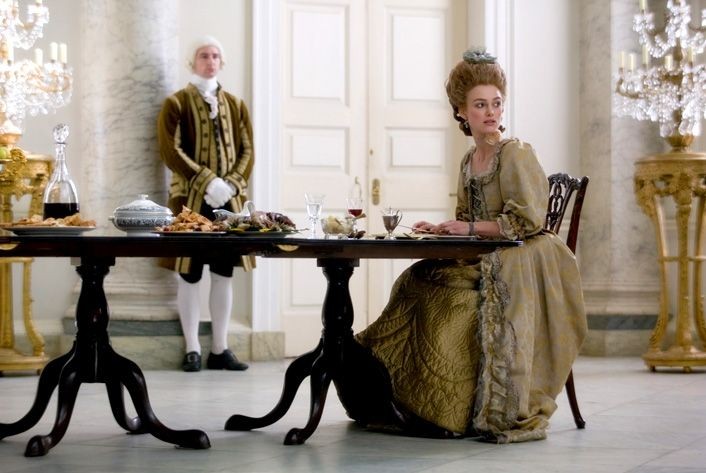
Throughout the rest of the movie, we see her search for freedom develop and backfire on her. At first, she thinks love can free her, but the love she receives from the Duke, a man who is more interested in what she can provide for him than in knowing her as a person, is not love at all, and can therefore not set her free. She takes an interest in gambling and politics, two hobbies that help set others free through public policy and money, but do nothing for her. She becomes a mother, which eventually just chains her to her gilded cage, as she is forced to place her love for her children first, while she herself will never experience the full, unconditional love she gives her children. And finally, she seeks freedom in Bess and charles grey, the two things in the world which seemed to belong to her and only her, her escape from the crushing weight of femininity, and that is also promptly taken away from her by her husband.
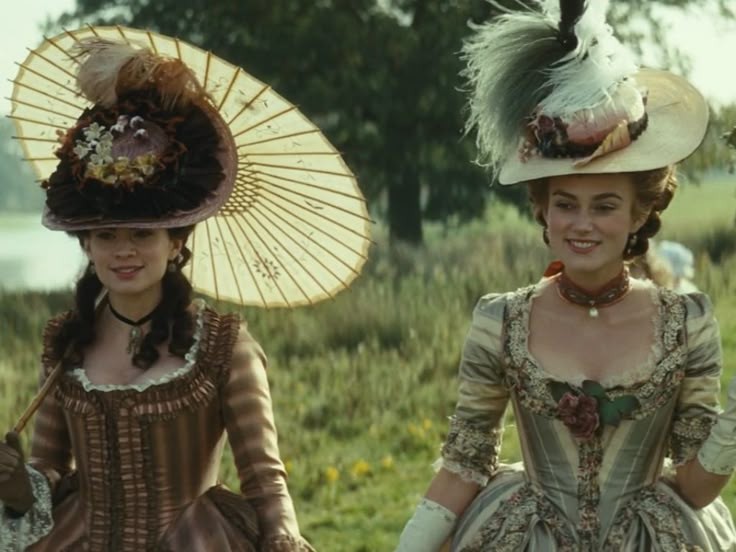
Lady Elizabeth Foster is certainly an interesting character.
While her backstory is heavily fictionalised for the film, adding a level of domestic violence that forces her to abandon her children and seek refuge wherever she can, her relationship with Georgiana seems to be more or less accurate to the historical figure’s life.
They met in Bath, and she quickly began a relationship with Georgiana’s husband. Whether or not the Duchess approved of the relationship, as the film implies, the truth is Elizabeth wasn’t allowed to see her children for 14 years, and had affairs with many different men before and after meeting the Duke of Davonshire, so it is not entirely known whether her union with him was a desperate attempt to keep her children in her life, or more so the need for a place to stay when her family would not take her back after her separation.
What fascinates me, however, is how this story seeks to humanise Lady Elizabeth. She was, by all accounts, the perfect antagonist to a story like this, the likes of which we would only see over two hundred years later in the figure of Camilla Parker Bowles.
It has been speculated for years amongst history buffs and generally unemployed people, like myself, that, had Lady Diana survived the horrid crash that took her from this life, the opinions surrounding Charles and Camilla’s affair might have been entirely different, and could indeed still be, in the next 200 years, as well as the way we see diana could still change.
Camilla and Charles story, sans Diana, is a simple one, and one we’ve heard many times in relation to nobility: man loves woman, man’s family decides woman is not good enough for man, woman is forced to marry someone else, man is forced to marry someone else, but the love is still there, they begin an affair, their respective partners die, they get married.
It is my belief that had it not been for two important factors, a. being Diana’s passing and b. being how unbearably unlikable both Charles and Camilla are, people would have a much different opinion on the love story of the current heads of the United Kingdom, but as previously stated, as we shift further and further away from generations that experienced the life of Diana Spencer firsthand and have heavy feelings of biased nostalgia attached to a deceased woman they have never met and only know through a carefully constructed public image, public opinion may start to shift.
Which brings us back to Bess, and why her character is sympathetic.
Lady Elizabeth Foster is, at her core, the foil to Georgiana Cavendish. They are both women who seek freedom from the shackles forced upon them by their gender, but who are unable to ever fully attain it and must therefore seek solace in each other, as that is the only way they can have their freedom: by having someone by their side who truly knows and sees them.
While Lady Foster was forced to abandon her children while running from abuse, Georgiana contemplates abandoning her children in search of love. Foster succeeds, but the price she pays is far too high, forcing her to bend to the Duke’s will for the chance to see her children again. She knows he cares nothing for her or her children, as he makes known when, in anger, he declares he cannot make her bastards his heirs; as well as she knows her stay in Davonshire House is contingent on her keeping her master happy, which she achieves by spreading her legs, either without knowledge or care for how this will affect her friend, Georgiana. The affair initially culminates in Georgiana being unable to look at her, and her stating that it is the only way she will be able to keep her children in her life, to which Georgiana replies: “there are limits to the sacrifices one makes for one’s children”, “No, there aren’t. No limits whatsoever.”, is Foster’s response.
By the end of the movie, Georgiana has learned that her friend was right. She is stuck in Davonshire House, forced to share a home and, occasionally, a bed, with a man who does not love her, unable to see the man she loves or the child she had with him, all so she could see her children grow up happy and healthy, because the truth is, she could never be truly free, whether she shared a rowdy life with Charles Grey, or served as the lap dog of her husband, freedom would never be something she could enjoy, it would always be a golden treat dangled in front of her eyes by the society who raised her, ready to be snatched back at the slightest sign of misbehaviour, and as Georgiana herself stated, that is not freedom.





 The Kitchen Sink
Leave a comment